A Gift for the Future: How AI Voice Cloning Can Preserve Your Voice for Memoirs and Audiobooks
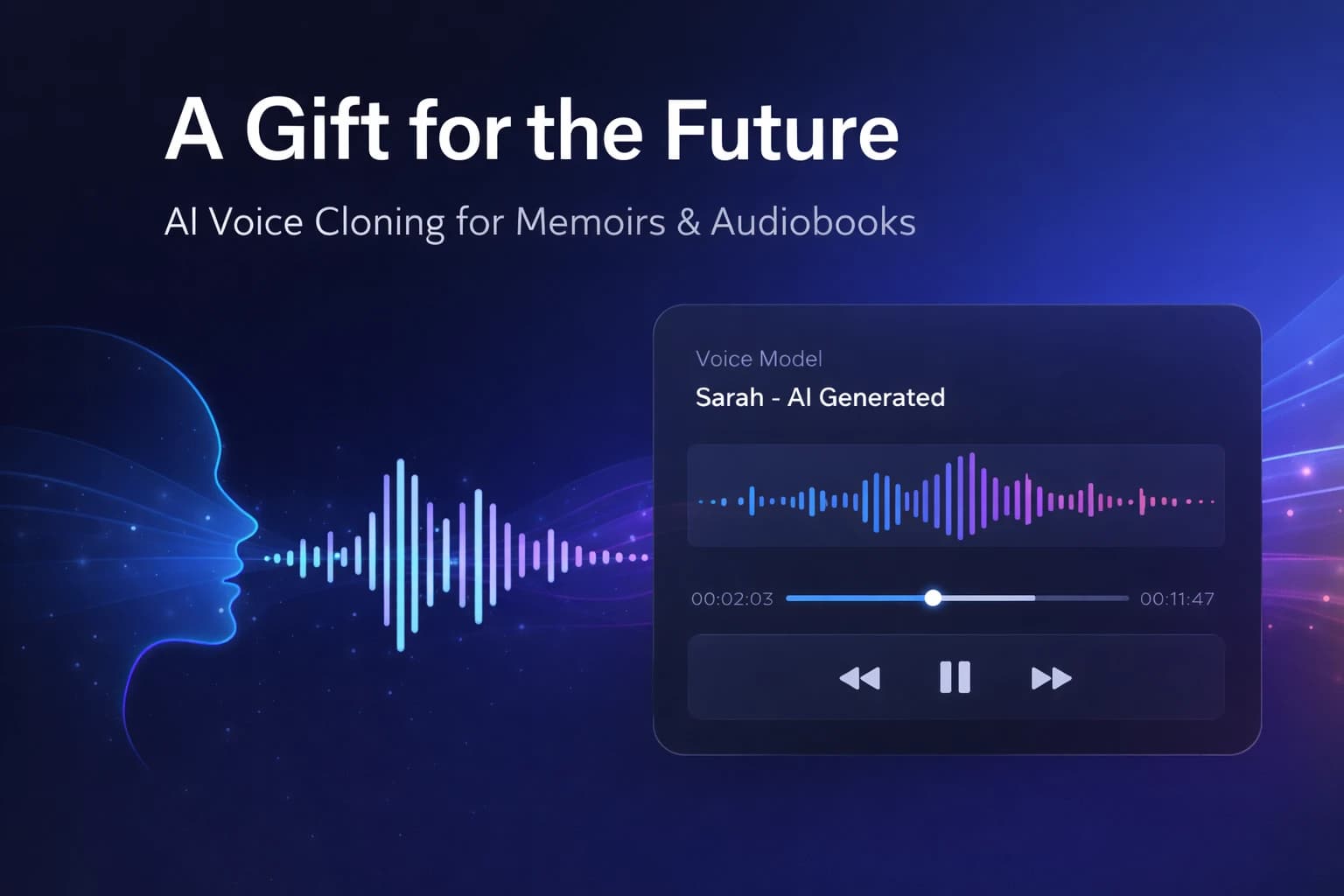
The Thing You Want to Save May Not Be the Book
When people start writing a memoir or planning an audiobook, they usually focus on the text first. That makes sense. But what loved ones and listeners often remember most is not just what you said. It is how you said it.
A pause before a difficult memory. A warmer tone when you are telling a family story. The way your voice changes when you are reassuring a child or reading something deeply personal. Those details are hard to preserve on the page alone. That is why more people are starting to treat AI voice cloning as a form of voice preservation, not just a content tool.
If your goal is to create something that can still speak in your voice years from now, a one-time recording is only part of the answer. A reusable voice model is different. It gives you a way to generate future narration, memoir chapters, family messages, or audiobook updates without starting from scratch every time. That is where AI voice cloning becomes practical.
Why Voice Preservation Is Better Done Early
"I'll record it later" sounds reasonable until later becomes the moment you actually need it.
Voices change. Age changes them. Fatigue changes them. Medical treatment changes them. Disease can change them quickly. In its Voice Preservation guide, the ALS Association makes the timing issue very clear: whether someone is considering voice banking, message banking, or voice cloning, it is best to start while the voice is still stable.
This is why voice preservation is not only a topic for older adults or patients facing a diagnosis. It matters for memoir writers, parents who want to leave something lasting for their children, creators who want a long-term voice asset, and anyone who wants their future audio work to still sound recognizably like them.
The hard part is not the software. The hard part is deciding to preserve the voice before there is pressure, urgency, or regret attached to it.
This Is Already Happening in Real Life
A clear celebrity case: James Earl Jones
One of the cleanest public examples is James Earl Jones, the iconic voice of Darth Vader. In 2025, Disney officially described a new AI-powered interactive version of Darth Vader created with the close involvement of Jones's family. The family also said that he had always wanted fans of all ages to keep experiencing the character's voice.
What makes this example useful is not just the technology. It is the permission structure behind it. The voice was not simply copied because the tools made it possible. It continued under a clear authorization framework, with named participants and explicit involvement from the family. For anyone thinking about personal legacy, that is the real lesson.
You may also see Bruce Willis mentioned in discussions about AI voice or digital likeness licensing. That story has been widely repeated online, but parts of it were later disputed and clarified. It is a good reminder that for voice legacy planning, rumor is not a reliable template. Clear authorization is.
A more personal case: preserving a family voice
Celebrity cases get headlines, but ordinary family stories explain the emotional value better. The ALS Association shared the story of Jared Salomon's family, where a father's voice was preserved before he lost the ability to speak. Later, that preserved voice was used in a wedding message. It was also used to record children's stories for the next generation.
That use case matters because it is not about novelty. It is about continuity. A preserved voice can become part of family memory, personal storytelling, and future communication in a way a silent archive never can.
For people living with ALS or other conditions that may affect speech, this is often the difference between saving a record and saving a presence.
What You Should Preserve, Not Just Record
The first mistake people make is assuming one short introduction is enough. Usually it is not.
If you want a voice model that can support memoir narration, audiobook production, and personal legacy uses, the source material should cover more than one style of speaking. In practice, three kinds of material matter most.
- Long-form narration: reading paragraphs, life stories, memoir passages, or chapter-like material. This helps the model hold together over longer stretches of speech.
- Everyday personal phrases: greetings, reassurance, common expressions, recurring family phrases, and short messages that sound deeply familiar.
- Emotional range: calm, reflective, warm, serious, and story-driven speech. Without this, a clone may sound technically similar to you but not emotionally like you.
The ALS Association also distinguishes between voice banking and message banking, which is a useful frame. Voice banking helps preserve the voice itself. Message banking preserves specific phrases people may want to hear again later, like "I love you," "I'm proud of you," or "Drive safely." If you are planning for memoir or family legacy use, both categories matter.
If the end goal is an audiobook, record some material that actually sounds like an audiobook. Reading a short sample of real narrative text is more useful than reading only detached sentences. Narration has its own rhythm. A model trained only on casual speech may still need extra work when asked to carry a long chapter naturally.
The Most Practical Workflow for Memoirs and Audiobooks
In practice, the best workflow is rarely "record today, generate the whole book tomorrow." The more stable approach looks like this:
- Capture a clean voice source in a quiet environment.
- Build the voice model and treat it as a reusable asset, not a one-off output.
- Test short passages first, especially names, long sentences, emotional sections, and personal anecdotes.
- Move to long-form production only after the short tests sound believable.
If you need a starting point for the setup itself, Create a Custom AI Voice from Scratch covers the basics. Once the goal shifts from experimentation to preservation, though, the priority changes. You are no longer looking for any pleasant AI narrator. You are trying to hold onto the shape of a specific human voice over time.
That is why a focused voice cloning workflow matters more than a broad, generic TTS setup. For memoirs and audiobooks, I would strongly recommend thinking in two layers.
- The work layer: foreword, memoir chapters, author notes, audiobook narration, family history recordings.
- The legacy layer: future greetings, wedding messages, birthday notes, short letters, bedtime stories, or reflections you want loved ones to hear later.
This split keeps the project practical. Even if the full memoir or audiobook takes another year, you have already saved the part that is hardest to recreate later.
Before You Talk About Legacy, Set the Permissions
The emotional side of voice preservation is obvious. The permission side is where many projects get messy.
If it is your own voice, decide early who can access it, whether it can be used commercially, whether text can be rewritten in your voice, whether use continues after death, and who has final control over future outputs. If the project involves a parent, spouse, patient, or another family member, these questions matter even more.
The biggest risk in voice legacy projects is usually not model quality. It is ambiguity. Family members may assume something is allowed. A platform may assume a different scope of use. A future collaborator may not know what the original consent covered. That is why voice preservation works better when the usage rules are documented at the same time the recordings are made.
This is also why trust and safety are not separate topics. They are part of the workflow. Voiceslab's guide on building a secure AI voice-cloning platform makes the same point from the product side: consent, revocation, transparency, and auditability should exist from the beginning, not as afterthoughts.
If you plan to publish a memoir or audiobook publicly, add a plain-language disclosure explaining that some narration was generated using an authorized AI voice model. Readers and listeners generally respond better to clarity than to concealment.
Why Trust This Guide
This guide is written from the perspective of teams and creators evaluating practical AI voice workflows, not just headline claims. The focus here is on what actually matters in use: whether a voice still feels like the same person, whether long-form narration stays stable, how easy revisions are, and whether permission boundaries are clear.
That is a more useful standard than broad promises about "human-like audio." For memoirs, audiobooks, and family archives, emotional accuracy and usage clarity matter more than marketing language.
The Best Time to Preserve a Voice Is Before You Need It
Some gifts only reveal their value later. A preserved voice is one of them.
If you are writing a memoir, planning an audiobook, or simply trying to leave something more personal than text behind, now is the right time to start. Save the voice first. Then decide where it will appear later: in a book, in a chapter intro, in a wedding message, in a family story, or in a recording meant for someone years from now.
If you want to turn that idea into a usable voice asset, start with voice cloning. If you are still comparing timing and cost, you can also review pricing. Words preserve what you meant. A voice preserves more of who you were. For a memoir or audiobook meant to last, that difference is hard to overstate.