Why VoicesLab Is the Best AI Voice Cloning Platform for AI Podcasts
Podcasting has a strange production problem: the more consistent your show becomes, the more fragile it gets.
Your listeners expect the same host energy, the same pacing, the same intro style, and the same familiar voice every week. But real production never stays that clean. Scripts change after recording. Sponsor reads get updated late. A line needs to be fixed after the edit is already locked.
That is where AI voice cloning stops being a novelty and starts becoming a serious podcast workflow tool. If your goal is to build an AI podcast workflow that still sounds human, VoicesLab has a strong case for being the best fit.
What podcasters actually need from AI voice cloning
Podcasters do not wake up asking for a neural voice model. They ask for simpler things:
- a faster way to fix mistakes
- a way to keep the host voice consistent across episodes
- a cleaner workflow for intros, outros, ads, and pickups
- more room to scale into clips, alternate versions, and multilingual experiments
That is why the best AI voice cloning platform for podcasts is not just the one with the most features. It is the one that solves production friction without making the show sound artificial.
Why generic AI voices usually fall short in podcasts
Generic text-to-speech can work for trailers, experimental segments, or internal drafts. But for a real podcast, it often breaks down.
The first problem is recognition. Podcast audiences build a relationship with a voice over time. If the voice suddenly sounds like a stock narrator, the show loses part of its identity. The second problem is rhythm. Many generic voices can pronounce words correctly but still miss the conversational pacing that podcast listeners notice immediately.
There is also a trust issue. A podcast lives much closer to the listener than most written content. You are literally in someone's ears while they commute, walk, or cook. That makes unnatural delivery much harder to hide.
This is why podcasters tend to care less about "can AI speak" and more about "does it still sound like my show."
Where VoicesLab fits better than a typical AI voice tool
VoicesLab is a better fit for AI podcasts because its product direction already matches the way podcast creators think about voice. The platform is built around reusable voice identity: creating a custom voice, generating natural-sounding audio, and carrying that same voice across content formats.
If you are building a podcast workflow, voice cloning is useful in the moments that happen after the first recording session, not just during it. That includes:
- fixing a single sentence without reopening a full session
- updating intros and outros across multiple episodes
- regenerating time-sensitive lines
- creating short promos from the same voice
- testing alternate hooks before publishing
For podcast production, those small wins add up quickly. You save time, but more importantly, you protect the tone listeners already recognize.
The biggest reason: it keeps your podcast voice reusable
Most podcast teams do not actually need "AI podcast generation." They need a reusable version of the host voice that can support the rest of the production system.
That is a different goal. A reusable voice lets you keep the show's identity stable even when the workflow gets messy. You can record less from scratch, patch more precisely, and publish faster without turning the show into something that feels synthetic.
That is also why VoicesLab's AI voice cloning makes sense for podcast creators who already have a recognizable style. Once your listeners know your cadence, humor, or way of landing a transition, you do not want to reset that identity every time you add AI to the stack.
Better podcast use cases than people expect
Most people imagine AI podcasting as "type a script, generate an entire episode." That is possible, but it is not where the most practical value starts.
Pickups after the edit is locked
This is one of the most useful real-world scenarios. You finish the episode, export the timeline, and then notice a broken sentence, a missing word, or an outdated mention. Re-recording can be annoying, especially if the host is unavailable or the original mic setup is gone.
Voice cloning gives you a cleaner path for those small repairs. Instead of reopening the entire session, you generate a short fix that matches the voice identity more closely than a rushed re-record from a different environment.
Intros, outros, and recurring segments
Podcast workflows often repeat the same structural parts: intro, episode framing, sponsor transition, CTA, sign-off. Those sections are ideal for AI-assisted reuse because they are short, formulaic, and brand-sensitive.
If you can generate those segments in a stable cloned voice, you reduce repetitive recording without flattening the whole show.
Promo clips and audiograms
A podcast no longer lives only as a long-form audio file. You need clips for feeds, trailers for new listeners, launch announcements, and short versions for other platforms. With a reusable voice, you can create those assets faster while keeping the show recognizable.
If you are still exploring what style fits your show, browsing a voice library can help you think more clearly about tone and presentation before you commit.
Multilingual podcast experiments
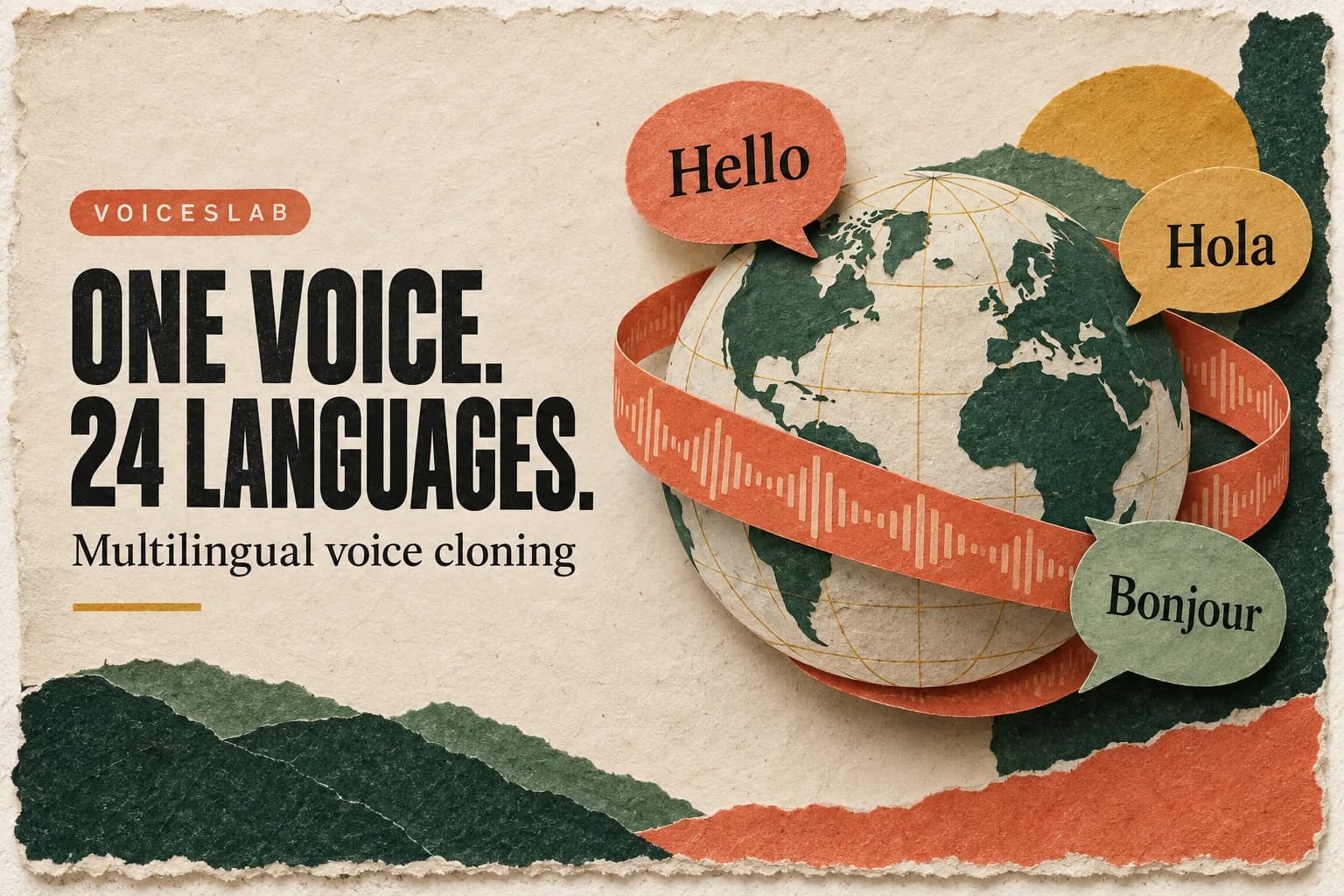
Not every podcast should go multilingual. But some should. If your show has educational, business, or niche community value, multilingual clips, recaps, or short trailer versions can extend its reach without forcing you to rebuild the whole brand.
This is where a voice-cloning-first workflow is much more interesting than a generic translated voice. Even if the format starts small, the podcast still feels like the same show.
What makes VoicesLab the best choice for this audience
VoicesLab is not necessarily the best choice for someone who wants the most experimental voice lab, the most extreme parameter control, or a huge menu of novelty voices for entertainment projects. But that is not the audience this article is about.
For podcasters who care about natural delivery, brand consistency, and fast production fixes, VoicesLab is easy to argue for because it aligns with the real job:
- it focuses on custom voice identity, not just generic output
- it supports podcasts and creator content as a clear use case
- it fits a workflow where you need to generate useful audio repeatedly, not just once
- it stays close to the practical question of "does this help me publish better episodes?"
The best AI podcast tool is the one you actually keep using after week one.
A better way to think about AI podcasts
If you are serious about AI podcasting, it helps to stop thinking in extremes.
You do not have to choose between "everything is recorded manually" and "the whole podcast is generated by AI." Most strong workflows sit in the middle. The host still drives the show. AI voice cloning supports the parts that are repetitive, delay-prone, or expensive to redo.
That usually leads to a better production system:
- record the core performance naturally
- use voice cloning for patch lines and recurring segments
- generate promos and alternate versions from the same voice identity
- expand carefully into multilingual or scaled content only after the listening quality feels right
This is one reason VoicesLab works well for podcast teams. It fits the gradual adoption path. You can begin with one narrow job and expand once the workflow proves itself.
If your podcast also feeds into video, shorts, or creator education content, the related guide on voice cloning for YouTube creators is a useful next read.
Trust still matters in AI podcasting
The more natural AI audio gets, the more important it becomes to use it responsibly.
For podcasts, that usually means keeping the boundaries simple. Use your own voice or clearly authorized voices. Be careful with guest material. Do not turn AI cloning into an invisible shortcut that breaks trust with collaborators or listeners.
This is another reason platform positioning matters. A tool built around reusable creator voices and clearer authorization logic is a better long-term fit than one that treats voice as a disposable effect. If this part of the workflow matters to you, VoicesLab's broader direction is also consistent with Building a Secure AI Voice-Cloning Platform.
Why trust this guide
This recommendation is written from the perspective of podcast and creator workflows, not from a benchmark lab. The focus is on editing friction, publishing cadence, voice consistency, and repeat production.
FAQ
Can AI voice cloning replace podcast recording completely?
It can for some formats, but that is not the smartest starting point for most shows. The strongest use usually begins with selective support: pickups, recurring sections, promos, and controlled expansions into new formats.
Is VoicesLab better for podcasts than a generic AI voice generator?
If your goal is a recognizable show voice, yes, usually. Generic voices can read a script, but they often struggle to preserve the identity that makes a podcast feel familiar from episode to episode.
What is the fastest win for podcast creators using voice cloning?
For many teams, it is post-edit pickups. That is where time savings become obvious fast.
Final thoughts
The best AI voice cloning platform for AI podcasts is not the one with the loudest demo. It is the one that helps your show stay recognizable while production gets easier.
That is the real case for VoicesLab. It helps podcasters keep their voice identity, move faster on revisions, reuse recurring segments, and scale into promos or multilingual experiments without losing the sound of the show.
If your next goal is not just to experiment with AI but to build a podcast workflow you can actually keep using, start with VoicesLab pricing, test a few practical podcast scenarios, and build from there.