Voice Cloning for YouTube Creators: Sound Like You in Every Language
Voice Cloning for YouTube Creators: Sound Like You in Every Language
Have you ever wished your YouTube videos could reach viewers around the world — without losing your voice, tone, or authenticity?
While subtitles and YouTube's new auto-dubbing tools offer quick fixes, they often come with compromises.
That's where Voice Cloning steps in — a smarter, more human solution to multilingual content creation.
The Traditional Way: Subtitles and Manual Dubbing
Most creators start by adding subtitles. It's easy and free — but it breaks the emotional connection. Viewers read instead of listening, and your natural tone, humor, or passion disappears.
Manual dubbing — recording new versions in multiple languages — can fix that, but it's expensive, time-consuming, and nearly impossible to scale if you upload regularly.
YouTube's Built-In Options: What Works and What Doesn't
YouTube has introduced two official solutions for multilingual audio: Audio Track Uploads and Auto-Dubbing. Both sound helpful, but they come with major trade-offs.
1. Audio Track Upload Feature (Manual Uploads)
YouTube's multi-language audio track feature allows creators to upload separate audio files for different languages — all under one video.
How it works:
-
Creators manually record or produce dubbed audio in other languages.
-
The new audio tracks are uploaded via YouTube Studio.
-
Viewers can switch between languages by clicking the settings icon and selecting "Audio Track."
Key advantage: You retain full creative control — over voice talent, tone, and audio quality.
Major limitation: You must create or record every language version yourself. For most creators, this is costly and time-intensive.
Availability: The feature is still being rolled out and isn't available to everyone yet.
So, while it gives control, it also demands heavy manual effort.
2. YouTube's Auto-Dubbing Feature
In late 2024, YouTube began testing auto-dubbing, a feature that uses AI to automatically translate and voice your videos in multiple languages — no human input required.
As of 2025, it's available to all creators in the YouTube Partner Program (YPP) — anyone with 1,000 subscribers and either 4,000 watch hours in the past year or 10 million Shorts views in the last 90 days. By mid-2025, over 80 million creators had access to it.
Supported languages (as of 2025):
-
Dubbing into English: Bengali, Dutch, French, German, Hebrew, Hindi, Indonesian, Italian, Japanese, Korean, Malayalam, Polish, Portuguese, Punjabi, Romanian, Russian, Spanish, Tamil, Telugu, Turkish, Ukrainian, Vietnamese.
-
Dubbing from Chinese: Dutch, French, German, Hindi, Indonesian, Italian, Japanese, Korean, Polish, Portuguese, Spanish.
However, there's a catch: these languages don't directly translate into each other. For example, Spanish → Japanese must first go through English as an intermediary, which can distort meaning and tone.
The truth about auto-dubbing's limits:
YouTube's AI dubbing sounds promising — but it still lacks personality. The tone often feels robotic, emotional nuance gets lost, and pronunciation can sound unnatural. For creators who rely on storytelling or personal voice identity, this can dilute your brand voice.
The Better Alternative: Voice Cloning with VoicesLab
Voice Cloning bridges the gap between control and convenience.
It captures your voice — its tone, rhythm, and warmth — and reproduces it naturally in any language.
With VoicesLab, creators can instantly generate multilingual versions of their videos that sound authentic, emotionally engaging, and unmistakably you.
What makes VoicesLab different:
-
Your real voice, in every language: Maintain your identity across all content. Our advanced voice cloning technology ensures that whether you're speaking English, Japanese, Spanish, or any of the 8 supported languages, it's unmistakably your voice.
-
Emotionally expressive dubbing: Not robotic — natural and human-like. Unlike YouTube's auto-dubbing, VoicesLab preserves the emotional depth, humor, and passion that make your content unique.
-
Multi-language support: Go beyond English and Chinese to reach global audiences. VoicesLab offers explicit support for 8 major languages: English, Japanese, Korean, Chinese, French, German, Arabic, and Spanish, with authentic accents preserved.
-
Fast, scalable workflow: Upload, choose a language, and let VoicesLab handle the rest. Generate multilingual audio tracks in seconds, not days. No need to book studios, hire voice actors, or wait weeks for manual dubbing.
-
Data privacy first: Your voice belongs to you. VoicesLab keeps it that way. The platform provides end-to-end encrypted voice cloning with enterprise-grade security standards, ensuring your digital vocal identity remains completely under your control.
Why Voice Cloning Outperforms Auto-Dubbing
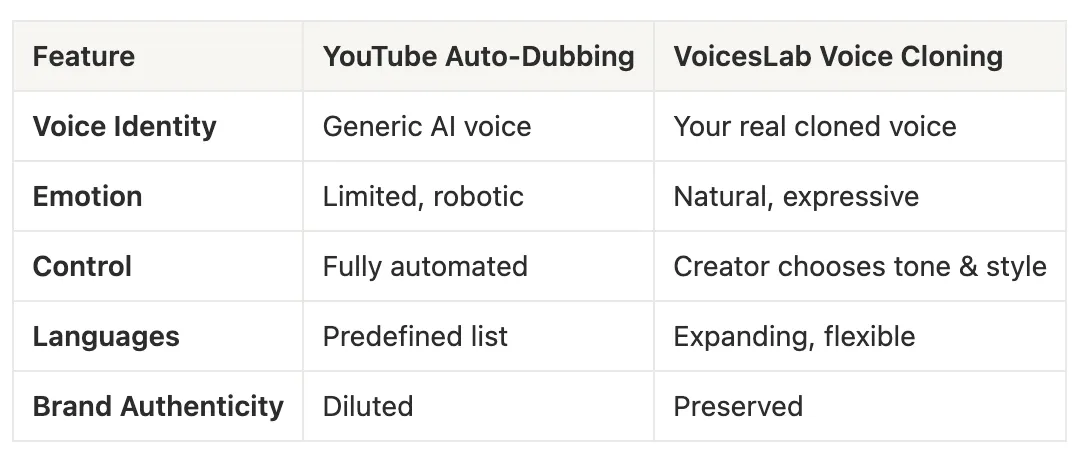
When you use Voice Cloning, you're not just translating your content — you're translating yourself.
Every laugh, pause, and inflection remains yours, even in another language.
Unlike YouTube's auto-dubbing which uses generic AI voices, professional voice cloning with VoicesLab captures your unique speaking style, emotional range, and personal brand identity. This means your Spanish-speaking viewers hear the same enthusiasm and personality as your English-speaking audience — something that robotic dubbing simply cannot achieve.
Final Thoughts
The future of global content isn't about automation alone — it's about authentic multilingual storytelling.
If you want your YouTube videos to connect across cultures without losing your identity, Voice Cloning with VoicesLab is the key.
It combines the power of AI with the soul of your real voice — so every viewer, in every language, still hears you.
Explore VoicesLab.io and start transforming your content today.